 VapeWholesaleHub
Atomizer Component Sourcing Behind the Finished Unit — Entry-Level Price Points
We ship atomizer to distributors in very different markets, and the same five questions come up almost every week. Rather than answer them in email each time, we have written them out properly here.

Pricing and Margin
Tiered pricing works best when the tiers match real customer behaviour. Most atomizer buyers will take the second tier if the step is modest and the third tier only if they can see a genuine reason to hold more stock.
Tiered pricing works best when the tiers match real customer behaviour. Most atomizer buyers will take the second tier if the step is modest and the third tier only if they can see a genuine reason to hold more stock.
Indicative reference points for planning purposes: entry tier from USD 1.28 per unit at 1000 units, mid tier at USD 1.39, and volume tier at USD 1.03 for full container quantities. These figures move with specification, packaging and freight, so treat them as a shape rather than a quote.
Positioning Atomizer on Your Shelf
Category data for atomizer is noisier than it looks. Promotions, weather and local competition all move weekly numbers, so read three months at a time rather than reacting to a single week.
Quality Control in Practice
Train whoever receives atomizer cartons to note anything unusual at the point of unloading. Damage discovered at the dock is a freight claim; damage discovered a week later is your problem.
AQL sampling gets a lot of attention, but for atomizer the more useful habit is simply measuring the same three things on every single batch. Trend lines catch problems that pass/fail checks miss.
- Keep sealed retained samples from every production batch.
- Model landed cost, not ex-works price, when comparing quotes.
- Rotate stock by batch code rather than by delivery date.
- Check carton dimensions against your freight quote before confirming.
- Agree the tolerance band in writing before approving artwork.
The Specification That Matters
Specification sheets are where a atomizer deal is won or quietly lost. Two samples can look and taste the same while using different coil wire, different wicking density and different tolerances on the mouthpiece. Those details decide how the unit behaves in week three rather than minute three.
Where possible, tie part of the atomizer payment to inspection against the written spec. It focuses attention on the numbers rather than on the relationship.
| Product category | Open system |
|---|---|
| Resistance band | 1.0 - 1.2 ohm |
| Capacity tolerance | +/- 5% |
| Puff count method | Machine cycle 2s on / 18s off |
| Master carton | 400 units |
| Carton weight | 11.2 kg |
| Shelf life | 12 months |
| Storage | 15-25 C, dry, away from direct light |
Logistics That Protect Margin
Split atomizer shipments across two sailings when the order is large enough. It costs slightly more but removes the risk of a single event wiping out a full quarter of stock.
Freight is the hidden half of atomizer unit economics. A denser master carton can save more per unit than a hard negotiation on factory price, because the saving repeats on every reorder rather than once.
Where Demand Is Heading
One shift worth planning for: shorter atomizer reorder cycles with smaller average drops. It favours suppliers with flexible production slots over those who only want large annual commitments.
Practical Checklist
- Rotate stock by batch code rather than by delivery date.
- Agree the tolerance band in writing before approving artwork.
- Keep sealed retained samples from every production batch.
- Check carton dimensions against your freight quote before confirming.
- Plan the switch from air to sea freight before you need it.
- Model landed cost, not ex-works price, when comparing quotes.
Frequently Asked Questions
Can I mix strengths in one order?
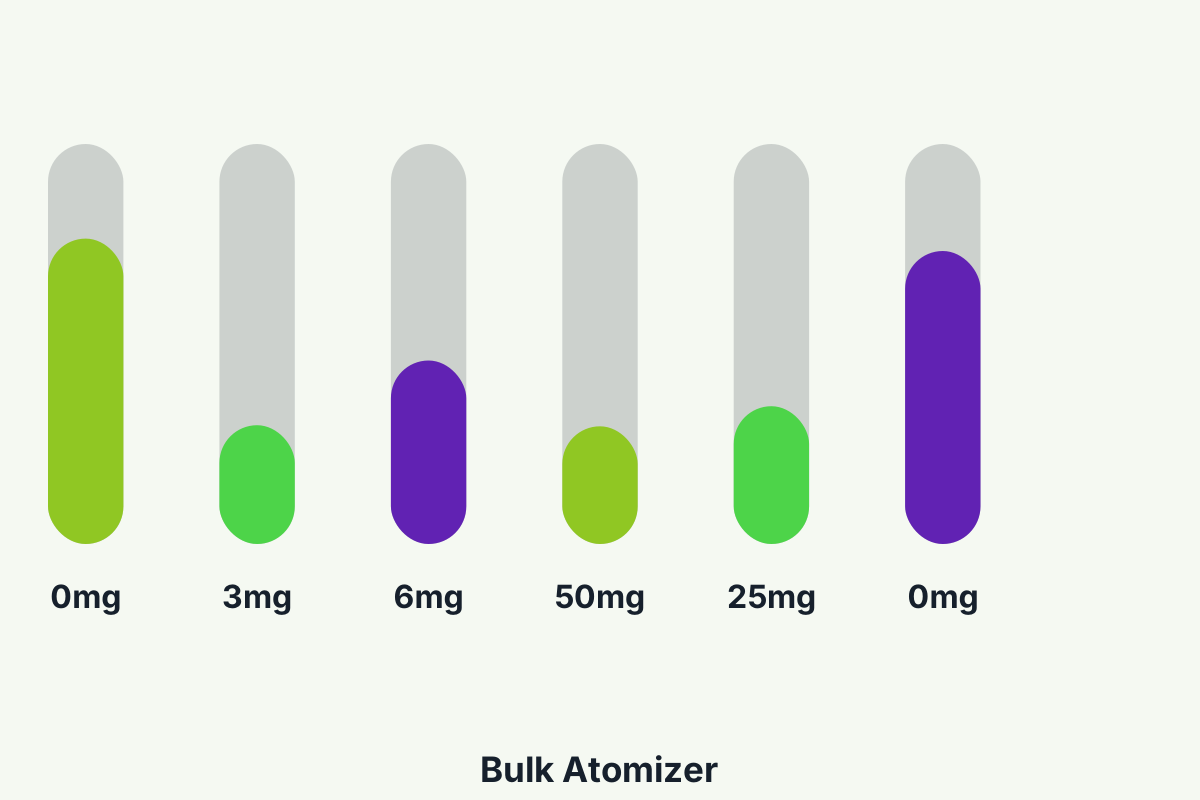
In most cases yes, as long as each strength meets the minimum run length. Mixed strength cartons are popular with retailers building their first display because they show the full ladder without over committing.
How do you handle a short shipment?
Cartons are counted and weighed before dispatch and the figures are shared with you. If something is short on arrival, the packing record and the carrier documentation are both available, which keeps the claim straightforward.
What if a batch does not match the sample?
Keep the retained samples from the approval stage. If a delivered batch measurably differs, we compare against the retained set and resolve it against the production record. This is why we insist on sealed retained units from every run.
What information do you need to quote?
Target specification, approximate quantity, destination and any packaging requirement. With those four we can usually come back with a costed option the same working day rather than a request for more information.
Do you hold stock for regular customers?
For established programmes we can reserve production slots and, in some cases, hold finished atomizer stock against a forecast. It removes most of the lead time risk from a reorder and is worth discussing once volumes are stable.
Next Step
If you are comparing options right now, send us the specification you have been quoted elsewhere. A side by side reading usually shows where the price difference actually comes from, and that is the most useful first conversation to have.
Related Reading
- Atomizer Specifications Every Buyer Should Check — Freight Included
- Atomizer vs Standard Alternatives: What Changes for Your Shelf — First-Time Importers
- How to Brief a Factory on Atomizer — Cash-and-Carry Formats
- Atomizer Storage Life Extension Through Better Handling — Mixed Cabinets
- Atomizer Product Testing Laboratories Explained — Mixed Cabinets
- Atomizer Assortment Depth Versus Breadth — a Factory Floor View